
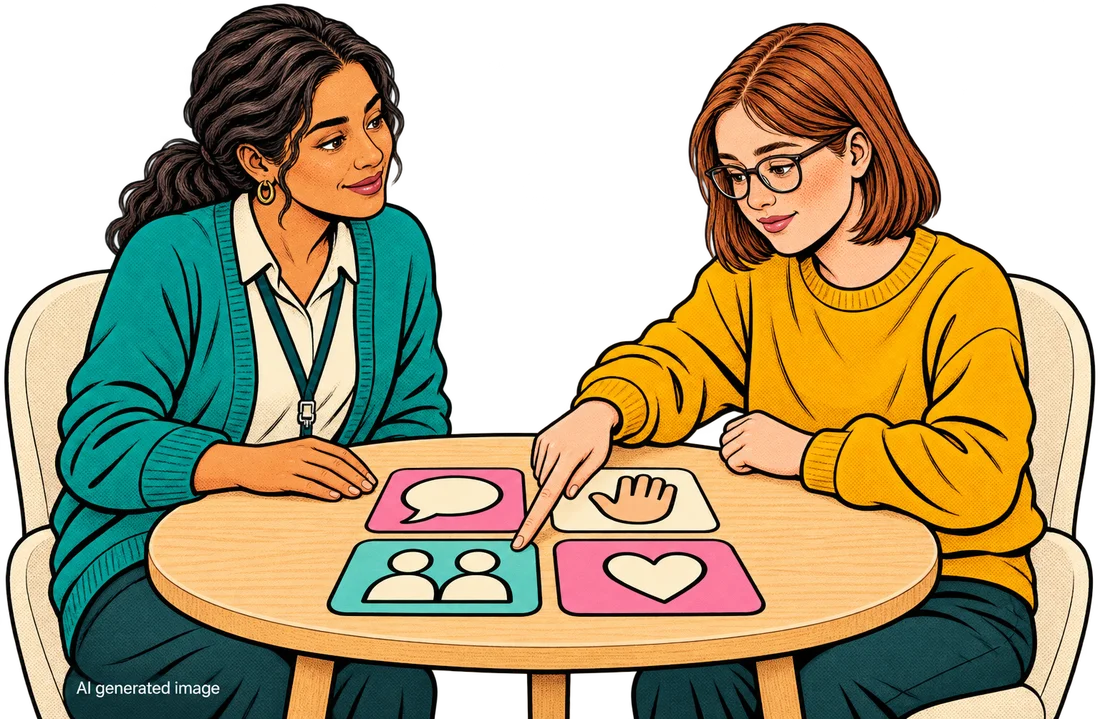
SEND partnership: the same learning, adapted with care
We plan sessions with your SENCO and our educational psychologist, so pupils with SEND get this learning in a way that works for them.
Why it matters
The Children's Commissioner's 2025 report found that young people with SEN were more likely to have seen pornography: 76%, against 69% of those without.
Some profiles raise the risk of grooming or people-pleasing. Direct, honest communication can also be a protective factor. We do not treat disabled pupils as “too young” for this learning.
Source: Children's Commissioner for England, August 2025.
Who you plan with
Amanda Clay is an educational psychologist specialising in SEND, with lived experience and a focus on protecting more vulnerable learners.
She works with your SENCO and DSL before any session, alongside founder Larissa Astara Gray, who is herself late-diagnosed neurodivergent.
How sessions are adapted
Every module deck carries its own SEND and accessibility notes. The adaptations we use most:
Vocabulary first
Key words previewed before the session, so no one meets a new term at the same moment as a new idea.
Concrete, not abstract
Less text, real-life examples, and fewer abstract concepts.
Slower scenarios
Scenarios that build gently, with simple decision trees showing what to do next.
Choice in how to answer
Written responses offered in place of speaking out loud.
No forced role play
No performance-based role play and no pressure to share personal experiences.
Same safeguarding frame
School staff in the room, an exit route, and any concern passed straight to the DSL.
How planning works
Conversation
A call with your SENCO and DSL about the group, the profiles to plan for, and anything recent that should shape the work.
Adapted outline
A one-page plan showing what will change and why. You approve it before anything reaches pupils or parents.
Delivery
The session runs with school staff present throughout.
Debrief
What worked, any safeguarding notes, and suggested next steps for the group.